The Justice Chronicles Volume 5: Bruesewitz v. Wyeth: The Government Doing What It's Supposed To Do

Last month the Supreme Court ruled 6-2 in the case of Bruesewitz v. Wyeth and I’m finding great satisfaction over it.

Here some background and the basic facts of the case: In the last few decades there has been an increased belief that there is a link between vaccines and illness, especially autism (you can read more of my views on this in a previous post). Out of this came a well founded fear that drug companies would no longer be willing to develop or manufacture childhood vaccines. In 1986 Congress passed the National Childhood Vaccine Injury Act (NCVIA). Section 22(b)(1) states this:

[n]o vaccine manufacturer shall be liable in a civil action for damages arising from a vaccine-related injury or death associated with the administration of a vaccine after October 1, 1988, if the injury or death resulted from side effects that were unavoidable even though the vaccine was properly prepared and was accompanied by proper directions and warnings

This act does not prevent anyone from suing a drug company if they did something wrong, but it did say you can’t sue if they did everything right and the person had a bad outcome.

Hannah Bruesewitz received the DPT (diphtheria/pertussis/tetanus) vaccine and later developed seizures. Her parents sued Wyeth claiming the vaccine caused this. Because they could not prove that Wyeth did anything wrong (or for that matter that there was a link between the vaccine and her seizures) the Supreme Court ruled in favor of Wyeth.

This puts me in a strange place as I almost never side with these large drug companies, and I virtually never side with Antonin Scalia, who wrote the majority opinion.

Our nation is currently full of people who believe that the free market can take care of our needs and government shouldn’t interfere. But I find that this was our government doing well what it should be doing. The free market would have made it unprofitable (and therefore impossible) to develop and manufacture vaccines that have become essential to childhood health. Congress passed, the President signed, and the Supreme Court affirmed this legislation.

Way to go.

The Justice Chronicles, Volume 4: Are We Ready To Go Backwards In Our Compassion?


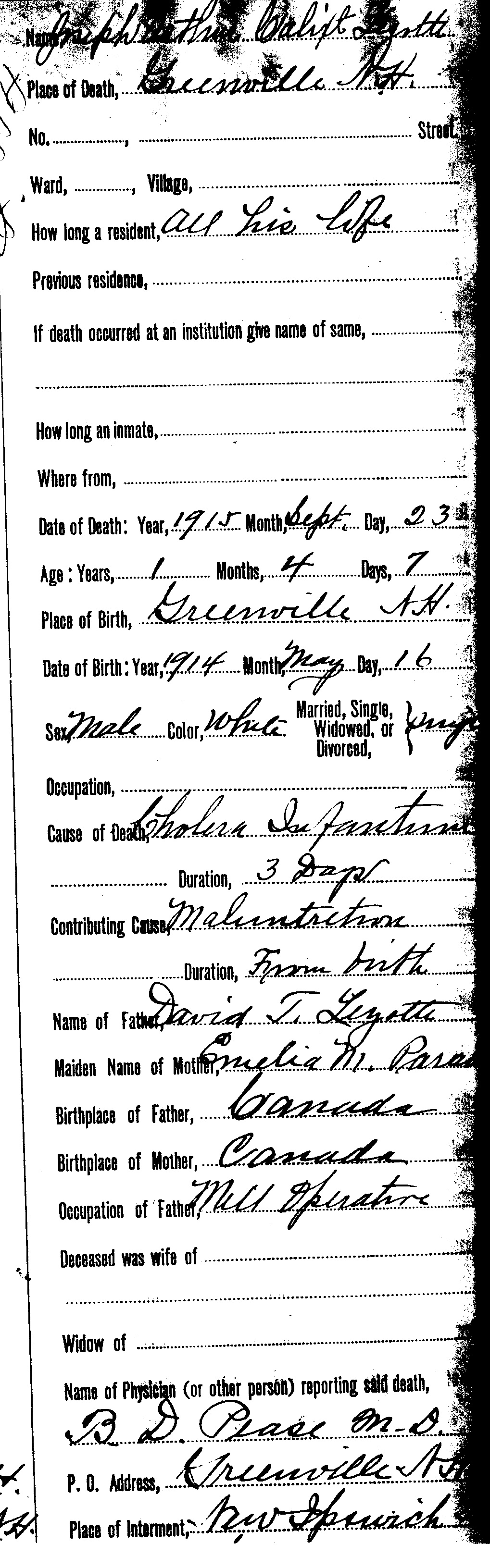
This image may be a strange way to start a blog on justice, but bear with me. This is the death certificate of Joseph Arthur Calixte Lizotte in Greenfield, New Hampshire. For the record he’s my 7th cousin twice removed, though I doubt I would have ever met or heard of him had he lived. The death certificate is hard to read, but he died in 1915 at 16 months of cholera (that he had for 3 days) and malnutrition (that he had for his entire life).

I came across this death certificate about 10 years ago when I was doing genealogy research and was struck and saddened by the fact that someone could die (at least partly) from malnutrition here in the United States. Simply put, the programs that would have saved him wouldn’t exist until 20 years later when the country was in the middle of a depression.

As I look over the political landscape today I worry that we may be headed back to those days. The Great Depression lasted only a decade but framed much of the 20th Century. Talk to nearly anyone who lived through those years and he will tell you that it was when people came together to help each other. It was also a time when our nation began to reflect on common values. Led by President Franklin Roosevelt (1882-1945) we developed programs to support the elderly (Social Security), the poor (Welfare, later known as Aid to Families with Dependent Children), and the unemployed (Works Progress Administration, Civilian Conservation Corps, and others). In later years help was expanded to include the hungry (Food Stamps). By the 1960s we began to provide health care to the elderly and the poor (Medicare and Medicaid).

Though far from complete, these programs ensured that most of the basic needs of most of us are provided. If my distant cousin had been born in 1934 instead of 1914 he likely would not have spent his entire life suffering from malnutrition. Because of progress made in plumbing and cleanliness he probably wouldn’t have even developed cholera, but if he did he would have had an 80% chance of surviving it (see the CDC for more information). All these programs were funded through the taxes we paid, and we paid them because they reflected our values.

Fast forward to today. I’m not sure we still share those values; as I read the political landscape, the only real value I see is that I should not be inconvenienced or charged for anything that will benefit anyone other than me. If you’re running for office, the fastest road to defeat lies in not promising to cut taxes. It’s become fashionable to claim that government does too much and is too costly. Meanwhile, on ground level, our schools, fire departments, libraries and infrastructure are crumbling. We are laying off teachers while school attendance continues to rise.

We’re also making it harder to access services. In 2008 here in San Diego, only 29% of those eligible for food stamps actually received them. Why not? These answers are always complicated but I don’t think anyone can deny that the process of applying is difficult and humiliating. Fortunately there has been some publicity around this and more hungry people are accessing food stamps, but the number is still too low.

This will ensure I can never run for office on any level, but I think we need to be willing to pay for what we value and be frank that we are all invested in good schools and full stomachs. We, as a whole, need to be compassionate not just with our minds but also with our wallets. We need to live in a society where nobody dies (even in part) of malnutrition.

The Justice Chronicles, Volume 3: Is Justice Devolving into Just Us?

In February of this year I started the Justice Chronicles, and talked about it in a religious context. Now I wish to talk about it in terms of how we govern ourselves. Hard to imagine an issue that is more polarizing than religion, but this may be it.

When someone in the government talks about justice it’s virtually always in the context of law enforcement: Protect me from the bad people and get rid of them if you can’t protect me. But it seems to me that justice ought to be much more. When we talk about justice in the public forum, why can’t we see it in the context of what we value as a society?

When I did marriage preparation I used to say this to the couple: Show me your checkbook and the last several months of your credit card statements and I’ll tell you what you really value. In other words, if I know where your money goes, I know what you think is important. We can use the same thing when we look at the budgets of the nation, state, and locality. You can look on a page at Wikipedia to see a pie chart of the 2010 US Federal Budget. The top categories are Social Security (19.63%), Department of Defense (18.74%), Unemployment/Welfare/Other Mandatory Spending (16.13%), and Medicare (12.79%).

So how are we doing? At first blush, not bad. Nearly 3/4 of the federal budget (73.24%) are these four categories, and three of them (Social Security, Unemployment, and Medicare) provide direct services to people in need: the elderly, the poor, and the sick. The other category protects us from outside forces that wish us ill.

But on the other hand, you can see how these four categories are weighted toward those who can advocate for themselves. I’m headed toward the Social Security/Medicare population at what seems like light speed, but it’s also true that the elderly vote in large numbers. They are essentially the exclusive recipients of Social Security and Medicare.

In 1961, in his farewell address, Dwight D. Eisenhower warned of the emergence of the Military Industrial Complex. He was, in this case, a prophet. No one, myself included, begrudges the brave men and women in uniform whatever they need to stay safe and come home. But the past 50 years we have been littered with stories of the military denouncing a weapons system, a jet, or a missile as unnecessary only to be overruled by a member of Congress who doesn’t want to lose the federal funds to pay for a factory in his/her district. We are owed efficiency from the Department of Defense every bit as much as the Department of Health and Human Services.

Finally, and this is my most salient point, is the status of our children in the federal budget. Where do we find them? Well, 8.19% of the budget is devoted to Medicaid and the State Children’s Health Insurance Program. Medicaid was designed in the 1960s as health insurance for the poorest among us. It is certainly that, but it is not necessarily weighted toward children. The fastest growing segment are elderly folk who need someone to pay for their stay in a skilled nursing facility (also known as a SNF or a nursing home).

Children, alas, are often looked at as an expense for the rest of us. That’s wrong. We need to look at our children (and I’m speaking globally as I have no children myself) not as an expense, but as the ultimate investment in our future. Study after study has shown that the more resources we give our children, the better off our society will be. But year after year we find that our schools are grossly underfunded, the people who care for our children the worst paid, and we don’t want to invest anything in children we don’t like (e.g. those who were born in other countries and came to the U.S. to contribute to an economy that will provide a sustainable standard of living). One of the charities I support, that you can find on the left side of this page, is Donor’s Choice. It’s a site where you can contribute directly to schools and classrooms who have needs that aren’t covered by their local school districts. I’m grateful for the opportunity to help, but I’m angry that these teachers need to go begging. Take a look and don’t be shocked by what you see.

Finally, the worst way we fail our children lies in the way we care for their health. Seniors, virtually all of them, have universal health care. If you are 62 or over and are here legally you are virtually guaranteed that you will be taken care of. Until then you’re pretty much on your own. If you’re a child and your parents are either wealthy, middle class, or destitute, you’re in good shape (either because your parents can afford health insurance or because you’re eligible for Medicaid). If your parents are working poor, or if they are employed by a company that does not provide health insurance, you’re pretty much counting on not getting sick. Your primary health provider is the emergency room where your parents are presented with a bill they can’t pay. If that happens everyone loses: the hospital doesn’t get their money and your parents file for bankruptcy because they can’t hope to pay the bill.

And there’s more. Here in San Diego we don’t have enough money to staff all of our fire stations and that has led to a policy of not staffing certain stations at certain times (called a “brown out”). Last Tuesday Station 44 in nearby Mira Mesa was out of service. When there was a call in that neighborhood, Station 38 responded. That was fine, until the family of 2 year old Bentley Do called 911 because Bentley was chocking on a gumball. The Do family lives a block away from Station 38. Because Station 38 was responding to a call that Station 44 should have taken care of, there was no station available to care for Bentley. When a station from farther away finally responded, it was too late. Two year old Bentley Do died.

There is a ballot measure in November that will raise the sales tax in San Diego by 0.5% (if you spend $100 on taxable items, your tax will increase by 50 cents). Fire and police protection will directly benefit from this. Yesterday the San Diego Union Tribune carried this letter to the editor from J.R. Bolger of Tierrasanta:

The death of young Bentley Do is cause for every San Diegan to grieve for and with his family. But my grief turns to outrage when your paper and its ilk use this tragic accident as a campaign issue in a drive to pass a sales tax increase! Your front-page headline (“Tragedy renews sales-tax debate” July 23) is yellow journalism at its finest and William Randolf Hearst must be smiling down on you.

It’s hard to live in San Diego and care about children. I pray that the family of Bentley Do is heartened by the fact that if this tax increase fails, Mr. Bolger of Tierrasanta won’t have to pay an extra 50 cents on a $100 purchase.

This just in: As I was writing this post the San Diego City Council decided not to pass the sales tax resolution. It’s a good day if you don’t want to spend the 50 cents, and a bad day if you need emergency services.

The Justice Chronicles, Volume 2: Rethinking Tzedakah

In my previous Justice Chronicles post I talked about the ladder of tzedakah. I’ve been thinking about this ladder and wonder if we need to rethink this. I take nothing away from the brilliance of Moses Maimonides, but he wrote nearly 900 years ago and built his ladder on one very specific theme. He believed that giving charity (or doing justice) becomes more altruistic as the receiver is not able to repay, either because they don’t have the means or don’t know the giver.

I still hold to the validity of the highest rung (enabling the recipient to become self reliant), but I’m not so certain of the 7th rung (giving when neither party knows the others identity). In the last few years we’ve read about and seen devastating tragedies with Hurricane Katrina, the Indian Ocean Tsunami, and most recently earthquakes in Haiti and Chile and we Americans have responded generously. Catholic Relief Services has already raised $90,000,000 for Haiti, and it’s all 7th rung tzedakah. None of us who gave know who will benefit, and nobody who benefits will know us.

But at the end of the day, is that a good thing? In the 12th century it was fairly difficult to be anonymous. Most people lived in small villages and didn’t travel much. If you wanted to give to someone without knowing who, and without them knowing you, you needed to search out a middle man. Now it’s much easier, and I think perhaps not as noble. The sheer volume of money that goes to Haiti, Chile, etc. shows how generous Americans are, but it also shows that it’s easy to write a check or call a toll free number and know we are doing good.

But what about tzedakah that needs to happen close to home? Can we be as generous and give while looking at someone in the eye? Several years ago I met a man from St. Eulalia Catholic Church in Winchester, Massachusetts. A few years before that he attended an event where the speaker was Mother Teresa. He was so impressed with her talk that he came up to her and gave her a $50 bill and said: “Give this to the poor.” She gave him the bill back and said: “No, you give this to the poor. Find someone who needs it and give it to him.” As he told me the story he explained that while it was hard to find someone in Winchester, Massachusetts who was poor, he was on a mission. He eventually found someone to give the money to, and it transformed him to actually meet someone who needed what he had.

I don’t normally do New Years’ resolutions, but last year I made one that I still hold to: I will not avoid eye contact with people who stand at intersections and ask for money. You know what I’m talking about: they hold signs that say “Please help. God bless,” or “Will work for food.” Admit it, you’ve hoped that the traffic light would work in your favor and you wouldn’t have the uncomfortable few minutes when you’re only separated by the car window. Most people don’t give them money because “they’ll just use it for booze or drugs.”

Is that true? Maybe it is, but maybe it’s because we don’t want to do level 3 (giving after being asked). Maybe it’s because giving to someone who asks is, on some level, creating a relationship that we don’t want to create. I’ll confess that I keep a $5 bill handy to give to these folks and in return I ask them to pray for me. Nobody has ever refused my request. OK, maybe they don’t have any intention to pray for me, and maybe they’ll just use the money to make themselves worse, but does that make my tzedakah worse or wasteful? If the only good that happened out of this encounter is that two strangers made eye contact, is that a bad thing?

Maybe it advances the cause of tzedakah.

The Justice Chronicles: Volume I

The recent events in Haiti have caused me to think a great deal about the role of justice. They suffered a 7.0 magnitude earthquake on January 12th and thousands lost their lives. Countless others survived but are in need of basic services (food, water, shelter, etc.) and that has lead to a very public debate.

Organizations like the Red Cross and Catholic Relief Services have raised millions of dollars. President Obama asked former presidents Bill Clinton and George W. Bush to spearhead a fundraising effort.

This raises lots of questions to me on the nature of justice and charity. In a previous post I spoke of medieval Jewish philosopher Moses Maimonmides (1120-1190) and his teaching on the “ladder of tzedakah.” Tzedakah is normally translated as “charity” but it means much more. In a sense, true tzedakah is not simply a rich person giving something to a poor person; it’s an act of fairness and justice, an act that works to restore all of us to equality.

More than that, the “ladder” part tells us that there are rungs, or levels; not all tzedakah is the same. Maimonmides taught that this ladder had 8 rungs:

1. Giving begrudgingly
2. Giving less that you should, but giving it cheerfully.
3. Giving after being asked
4. Giving before being asked
5. Giving when you do not know the recipient’s identity, but the recipient knows your identity
6. Giving when you know the recipient’s identity, but the recipient doesn’t know your identity
7. Giving when neither party knows the other’s identity
8. Enabling the recipient to become self-reliant

For most people who are giving to the relief in Haiti, it’s really the 7th rung. That’s pretty good particularly given that the people who will benefit from these donations will never have the opportunity to give back, but I wonder if we shouldn’t think more about moving to the 8th rung.

This may be too politically sensitive to discuss directly, so let me get to this at a slant. Going back a century, I think most people are aware of the name Andrew Carnegie (1835-1919). He founded United States Steel (now called USX). In building his empire he earned a phenomenal amount of money and when he retired he gave much of it away. In total, he donated approximately $350,000,000 and was instrumental in the building of over 2500 libraries. Even today the <a href="Carnegie Corporation is continuing Andrew’s vision.

Much of the work they do is 7th rung stuff. The people who fund the charity don’t know the people they help and they don’t know the donors. But when Mr. Carnegie was amassing his fortune, did he need to keep it all himself? Did his workers need to live in poverty and work in poor conditions so those of the next generation would have a library? In 1892 Carnegie broke the union that represented his workers. Had he worked with the union and given everyone a living wage, couldn’t that have been 8th rung tzedakah? Maybe Carnegie wouldn’t have been so famous, and maybe we wouldn’t have as many libraries, but workers in the late 19th and early 20th century might have had less poverty, disease, and shortened lives.

Maybe the earthquake in Haiti gives all the rest of us the opportunity to not only provide food and water, but also the tools to allow their economy to grow. Maybe this is our opportunity to make them better able to survive the next earthquake.

I entitled this “Volume 1” in the hopes that I’ll write about justice/tzedakah on a regular basis.